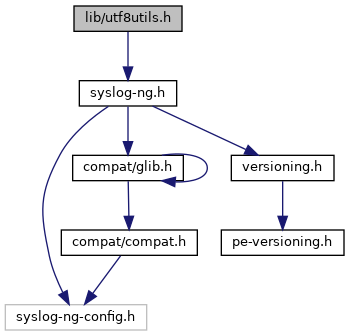
Go to the source code of this file.
|
| void | append_unsafe_utf8_as_escaped_binary (GString *escaped_string, const gchar *str, gssize str_len, guint32 unsafe_flags) |
| |
| gchar * | convert_unsafe_utf8_to_escaped_binary (const gchar *str, gssize str_len, guint32 unsafe_flags) |
| |
| void | append_unsafe_utf8_as_escaped_text (GString *escaped_string, const gchar *str, gssize str_len, guint32 unsafe_flags) |
| |
| gchar * | convert_unsafe_utf8_to_escaped_text (const gchar *str, gssize str_len, guint32 unsafe_flags) |
| |
| void | append_unsafe_utf8_as_escaped (GString *escaped_output, const gchar *raw, gssize raw_len, guint32 unsafe_flags, const gchar *control_format, const gchar *invalid_format) |
| |
◆ AUTF8_UNSAFE_APOSTROPHE
| #define AUTF8_UNSAFE_APOSTROPHE 0x02 |
◆ AUTF8_UNSAFE_QUOTE
| #define AUTF8_UNSAFE_QUOTE 0x01 |
◆ SANITIZE_UTF8_BUFFER_SIZE
| #define SANITIZE_UTF8_BUFFER_SIZE |
( |
|
l | ) |
(l * 6 + 1) |
◆ append_unsafe_utf8_as_escaped()
| void append_unsafe_utf8_as_escaped |
( |
GString * |
escaped_output, |
|
|
const gchar * |
raw, |
|
|
gssize |
raw_len, |
|
|
guint32 |
unsafe_flags, |
|
|
const gchar * |
control_format, |
|
|
const gchar * |
invalid_format |
|
) |
| |
- See also
- _append_escaped_utf8_character()
◆ append_unsafe_utf8_as_escaped_binary()
| void append_unsafe_utf8_as_escaped_binary |
( |
GString * |
escaped_string, |
|
|
const gchar * |
str, |
|
|
gssize |
str_len, |
|
|
guint32 |
unsafe_flags |
|
) |
| |
This function escapes an unsanitized input (e.g. that can contain binary characters, and produces an escaped format that can be deescaped in need, which is guaranteed to be utf8 clean. The major difference between "binary" and "text" form is that the receiver is able to cope with \xXX sequences that can incorporate invalid utf8 sequences when decoded. With "text" format, we never embed anything that would become not valid utf8 when decoded.
Here are the rules that the routine follows:
- well-known control characters are escaped (0x0a as
and so on)
- other control characters as per control_format (\xXX)
- backslash is escaped as \
- any additional characters (only ASCII is supported) as <char>
- invalid utf8 sequences are converted as per invalid_format (\xXX)
- utf8 characters are reproduced as is
This is basically meant to be used when sending data to 8 bit clean receivers, e.g. syslog-ng or WELF.
- See also
- append_unsafe_utf8_as_escaped()
◆ append_unsafe_utf8_as_escaped_text()
| void append_unsafe_utf8_as_escaped_text |
( |
GString * |
escaped_string, |
|
|
const gchar * |
str, |
|
|
gssize |
str_len, |
|
|
guint32 |
unsafe_flags |
|
) |
| |
This function escapes an unsanitized input (e.g. that can contain binary characters, and produces an escaped format that can be deescaped in need, which is guaranteed to be utf8 clean. The major difference between "binary" and "text" form is that the receiver is able to cope with \xXX sequences that can incorporate invalid utf8 sequences when decoded. With "text" format, we never embed anything that would become not valid utf8 when decoded.
Here are the rules that the routine follows:
- well-known control characters are escaped (0x0a as
and so on)
- other control characters as per control_format (\xXX)
- backslash is escaped as \
- any additional characters (only ASCII is supported) as <char>
- invalid utf8 sequences are converted as per invalid_format (\xXX)
- utf8 characters are reproduced as is
This is basically meant to be used when sending data to utf8 only receivers, e.g. JSON.
- See also
- append_unsafe_utf8_as_escaped()
◆ convert_unsafe_utf8_to_escaped_binary()
| gchar* convert_unsafe_utf8_to_escaped_binary |
( |
const gchar * |
str, |
|
|
gssize |
str_len, |
|
|
guint32 |
unsafe_flags |
|
) |
| |
◆ convert_unsafe_utf8_to_escaped_text()
| gchar* convert_unsafe_utf8_to_escaped_text |
( |
const gchar * |
str, |
|
|
gssize |
str_len, |
|
|
guint32 |
unsafe_flags |
|
) |
| |



 1.9.1
1.9.1